How to Automate Affiliate Management for Prop Trading Firms
Challenge purchases, resets, renewals. As your prop firm grows, so does the work behind every affiliate commission. Here's how to automate that work and make more time for growth.

Every challenge purchase, paid reset, or renewal can mean another commission to calculate. And when you're running an affiliate program for a prop firm, those transactions can add up pretty quickly.
The good news is that you can automate much of this work by connecting your checkout and trading CRM to affiliate tracking software. Commission calculations, reporting, and payout preparation can all become part of an automated workflow.
Imagine a trader buying a challenge today, paying for a reset next week, and purchasing another evaluation a month later. Depending on your affiliate terms, each of those transactions could earn a different commission.
Now multiply that by hundreds or thousands of purchases every month. How much time could you save by automating the process?
In this guide, we'll look at which parts of your affiliate program you can automate, how much time you could get back, and where you still need to be involved.
Key takeaways
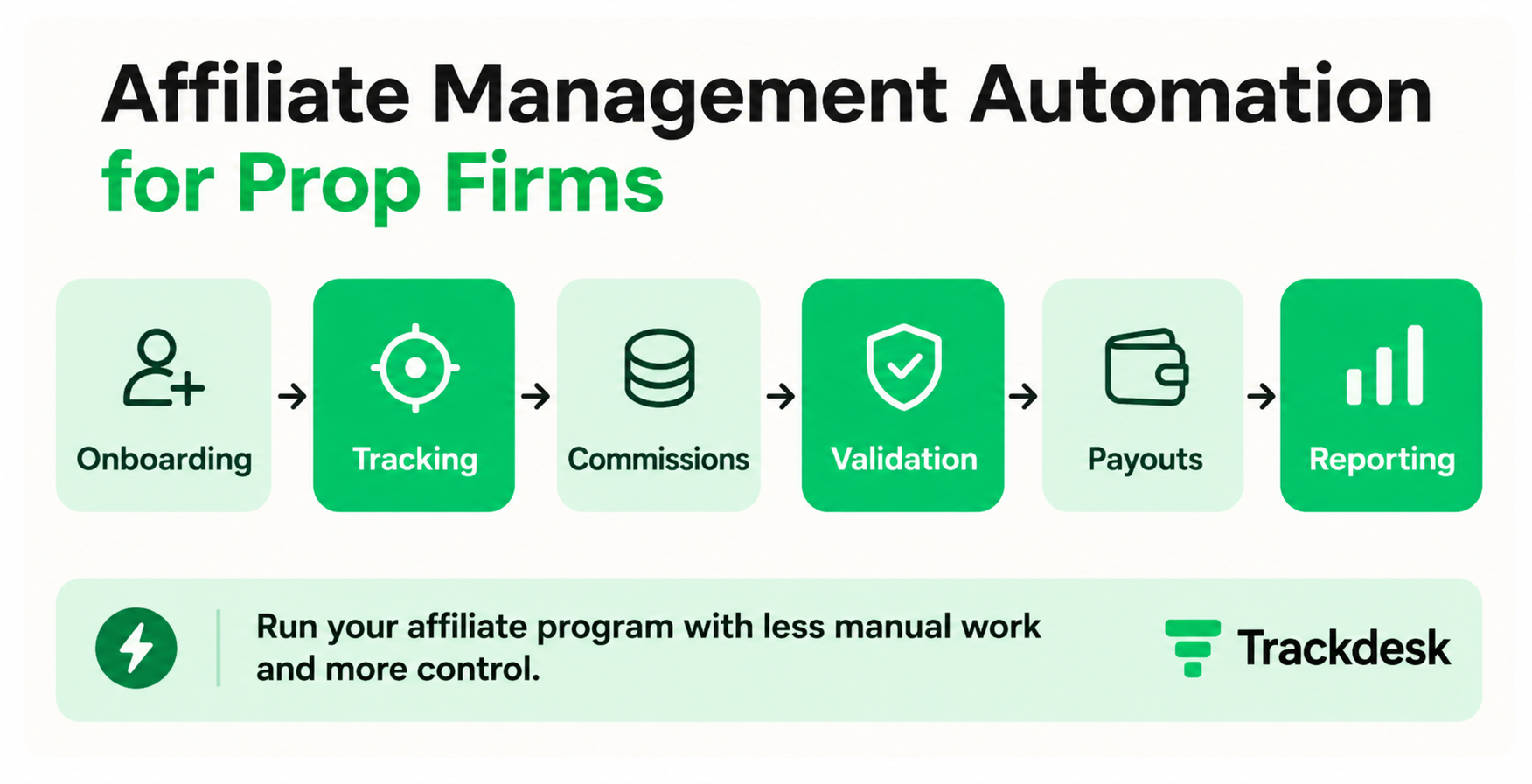
- Affiliate onboarding: Automate welcome emails and give partners access to tracking links, promo codes, and payment details through an affiliate portal.
- Affiliate tracking: Connect your prop CRM and checkout to affiliate tracking software to track challenge purchases, resets, and renewals.
- Commission management: Set different commission rates for first-time purchases, repeat purchases, and paid resets in Trackdesk.
- Commission validation: Connect refund and chargeback notifications, put commissions on hold, and check suspicious activity before approving payments.
- Affiliate payouts: Use the Trackdesk and Tipalti integration to simplify payments and track their status.
- Reporting and optimization: Automatically track partner performance, distinguish new traders from repeat purchases, and adjust commission tiers based on results.
Why should you automate affiliate management in your prop firm?
Prop trading affiliate programs need to track more than a trader's first purchase. Resets and renewals can generate additional commissions, depending on your affiliate terms.
Affiliate tracking software for prop trading brings purchases, partner records, commissions, and payouts together. You can spend less time matching records and more time working with affiliates.
How to automate affiliate onboarding
One partner needs a tracking link. Another asks where to add payment details. A trading educator wants to know which challenge purchases earn a commission. You shouldn't have to answer the same setup questions every time someone joins.
Start with the questions you answer over and over. Review your affiliate onboarding process to see which steps require your input. You still need to review applications, but sharing tracking links, sending welcome instructions, and collecting payment details can all be simplified with affiliate management software.
Affiliate self-service
Give your partners a place where they can find what they need without contacting you. The affiliate portal in Trackdesk gives them access to tracking links, coupons, and settlement information. They can also add their billing details and payment method before payout day.
Automated welcome emails and setup instructions
Once a partner is approved, there's no reason to send the same setup email manually every time. You can connect your email or CRM tools using integrations and automation templates in Trackdesk, including Albato workflows. After approval, send a welcome sequence covering challenge products, commission rates, promotional rules, and payment dates. That leaves more time for a conversation about the partner's audience.
Which decisions still need a human?
You still need to choose who represents your firm. Topstep, for example, requires partner approval and prohibits guarantees of profit, payouts, or funded status in its affiliate terms. Keep partner selection and promotional reviews with your team.
Automating affiliate tracking and commissions for prop firms
Should your affiliates earn a commission every time a trader buys a challenge? What about paid resets or renewals? Different prop firms handle these purchases differently.
FTMO, for example, rewards affiliates for certain first-time purchases, recurring Futures Evaluation payments, and eligible resets under its affiliate commission rules.
Goat Funded Trader, on the other hand, pays commissions on eligible challenge purchases and add-ons but excludes resets and self-purchases under its affiliate terms. Your affiliate software needs to support the rules that make sense for your own business.
Which purchases should earn a commission?
Your commission rules need to cover a few important questions:
- Does “first purchase” mean the trader’s first-ever purchase or their first purchase of a particular product?
- Which repeat attempts, paid resets, add-ons, and renewals qualify?
- Which discounts, taxes, and fees affect the commission base?
- Which commission rate applies when a partner's terms change?
- Should affiliates earn an additional commission when a trader reaches funded status?
If you pay 10% of the discounted challenge fee, the difference between the list price and the actual purchase amount matters. A $200 challenge sold for $160 earns $16 in commission. Calculate it on the original price and you'll pay $20 instead. Make that mistake 100 times and you've overpaid by $400.
A $40 paid reset at a 5% commission rate earns the affiliate $2. A free reset brings in no new purchase revenue. Base purchase commissions on the fee paid, rather than the evaluation account balance.
Once you've decided which purchases qualify, focus on setting profitable commission rates before configuring them in your affiliate software. Trackdesk lets you set fixed or percentage-based commissions for different conversion types, affiliate tiers, or individual partners. Set up challenge purchases and paid resets separately, then connect your checkout or prop CRM so it sends the eligible purchase type, amount, and any customer history needed to identify first purchases.
Even a correctly calculated commission can lead to a dispute if two partners believe they referred the purchase.
Resolving tracking link and coupon conflicts
A trader follows one educator’s link, then uses another partner’s discount code at checkout. Both partners may expect credit. To explain the outcome, you need a clear attribution policy and a record of the purchase.
Once you've agreed on a policy, your tracking software needs to apply it consistently. With the attribution settings in Trackdesk, you can decide whether the link or code takes priority. You can also choose first- or last-touch attribution. Click-versus-coupon priority applies account-wide, so agree the policy across product teams before promising partners different treatment.
Tracking resets and renewals
What happens when that trader comes back? One trader can have several evaluation accounts, and each account can generate several payments. Keep trader, account, and transaction IDs separate so you can recognize repeat purchases and avoid paying twice when a payment notification is sent twice.
For subscription-based evaluations, you also need a way to carry the original referral information over to later payments. With recurring subscription tracking in Trackdesk, your system can save the original click ID when a subscription starts with an affiliate coupon. For each later charge, send that referral information and a unique transaction ID through a server-to-server postback, following your attribution settings. The trader doesn't need to click the affiliate's link again.
Handling refunds, chargebacks, and affiliate fraud
You've worked out who referred the purchase. But what if the trader asks for a refund before payout day?
A challenge refund, a chargeback, and a fee reimbursement for a successful trader can affect commissions differently. Decide how to handle each before setting up your automation.
Keep commissions that are still under review out of your payout run. You can do this using conversion statuses and holds in Trackdesk to keep unapproved commissions out of billing. Connect refund notifications from your payment system so you can update the original conversion using its transaction ID. The refund integration guidance explains how to connect those events.
Set the handling rules with finance before the first disputed payment:
- Before settlement: Exclude a fully refunded purchase’s affected commission from the payment run and define what remains payable after a partial refund.
- After settlement: Agree how to adjust or recover a commission affected by a later chargeback.
- Trader fee reimbursements: Define separate rules for these. Goat Funded Trader, for example, offers a fee refund after a fourth payout for eligible accounts under its refund policy.
A hold gives your team time to review a commission. It doesn't automatically check for disputes when it expires, so make sure your payment system sends refund and chargeback updates.
The same principle applies to potential fraud: flag unusual activity for review before making a decision. Trackdesk provides suspicious-activity flags to help you spot clicks, conversions, or accounts that need investigation. A shared IP address or failed evaluation alone isn't proof of fraud. Review the evidence before rejecting a commission.
How to automate affiliate payouts
It's payout day. You've already checked the commissions and approved the balances. Why spend another afternoon copying affiliate details and amounts into your payment tool?
Automated payments with Tipalti
Connecting your affiliate platform to a payment provider saves you from entering approved amounts twice. The Tipalti integration in Trackdesk lets you initiate payments from approved settlements. You'll need a funded Tipalti account and registered payees. Once you initiate a payment, Tipalti updates the settlement status so finance can see which payments are complete.
Crypto payouts with Confirmo
For crypto payouts via Confirmo, Trackdesk prepares a file with the required wallet and currency details. Your team uploads it to Confirmo instead of entering the payment information manually.
Your team still needs to approve and fund payments. Creating a settlement does not transfer the money.
The Top One Futures case study is a good example of how this fits into a wider affiliate strategy. The firm combined Tipalti payouts with personalized outreach and a dedicated affiliate manager.
How can automation help you grow your affiliate program?
Are your affiliates bringing in new traders or repeat purchases?
An affiliate can look highly productive if every reset and renewal is counted as another customer. Before offering a higher commission, check what that partner is bringing in.
Start by separating first purchases, resets, and renewals in your performance reports. You can do this with customizable reports in Trackdesk. Save those views for regular partner reviews, and compare approved revenue, refunds, and commission costs.
Two questions can help you make better decisions during a partner review:
- Are they bringing in new traders or repeat purchases? Both can be valuable, but a higher commission should support your current business goal.
- Where are traders dropping off? A partner sending traffic without purchases may need a better offer or landing page. An affiliate who hasn't started promoting may need help getting started.
To see whether referred traders reach funded status or keep trading, combine affiliate reports with data from your prop platform. Include finance costs when assessing profitability.
Alongside your own recruitment efforts, you can also explore the Trackdesk Affiliate Marketplace to discover potential partners.
For a real-world example of how a prop firm can build its affiliate channel, the Nexgen ProTrader Funding case study shows how the firm generated $331,000 in affiliate-driven revenue in its first five months.
Rewarding the right partner behavior
Once you know which results you want to reward, you can automate changes to commission tiers instead of reviewing every partner manually. With affiliate tier automation in Trackdesk, partners can move between tiers based on revenue, payouts, or conversion count. Filter by conversion type if you want to reward specific purchases. If your goal is new trader acquisition, don't count renewals as new customers.
What can AI take off your plate?
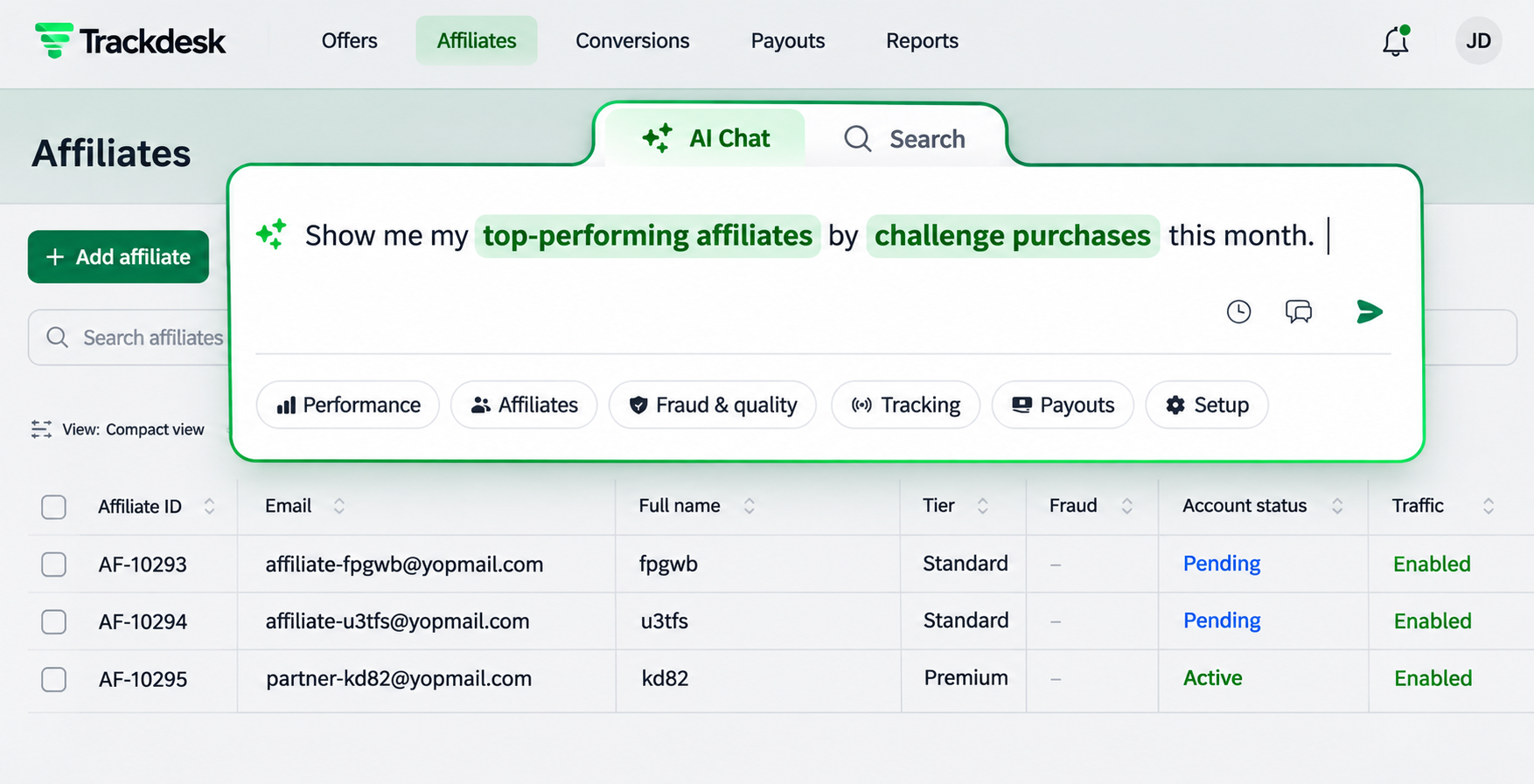
Even with automated workflows in place, you'll still have questions to answer and occasional changes to make. That's where the AI Assistant in Trackdesk can help authorized users find account information and carry out supported management tasks. Here are a few ways to use it in your daily work.
Before a partner meeting, ask AI to identify your top affiliates this month and show a partner's recent conversions. If you agree on a new tier or coupon, you can request that change too.
If an affiliate asks about a missing commission, ask AI to check whether the conversion's postback was sent. You can also investigate suspicious conversions before deciding how to handle them.
Before payout day, ask AI to check for missing billing details or payment methods. After reviewing pending conversions, you can request approval of the relevant ones.
Each change requires approval. Review the proposed values and verify important figures against the records before confirming.
Prefer working in an external AI tool? The MCP integration in Trackdesk lets you connect it within your account permissions and supported actions.
How much time and money can automation save your prop firm?
Let’s say your affiliate program has 100 approved partners and tracks around 1,000 payments every month. Some traders are buying their first challenge; others are paying for resets or renewing their evaluations.
On top of that, there's the work of reviewing applications, investigating attribution issues, checking refunds, preparing payouts, and answering partner questions.
Here’s how the monthly workload could change once those routine tasks are automated.
The table includes the time your team still spends on checks and maintenance after setup. The 40 attribution issues and 30 refund cases are part of the same 1,000 payments.
| Monthly task | Manual | With automation | Time saved |
|---|---|---|---|
| Reviewing applications (20) | 5h | 2h | 3h |
| Checking attribution issues (40) | 4h | 2h | 2h |
| Calculating commissions (1,000 payments) | 25h | 2h | 23h |
| Checking refunds and chargebacks (30) | 4h | 2h | 2h |
| Approving commissions (4 reviews) | 4h | 2h | 2h |
| Preparing payouts (40 payees) | 3h 20m | 1h | 2h 20m |
| Preparing reports (4) | 4h | 1h 20m | 2h 40m |
| Answering partner questions (40) | 4h | 2h | 2h |
| Maintaining automation | 0h | 2h | −2h |
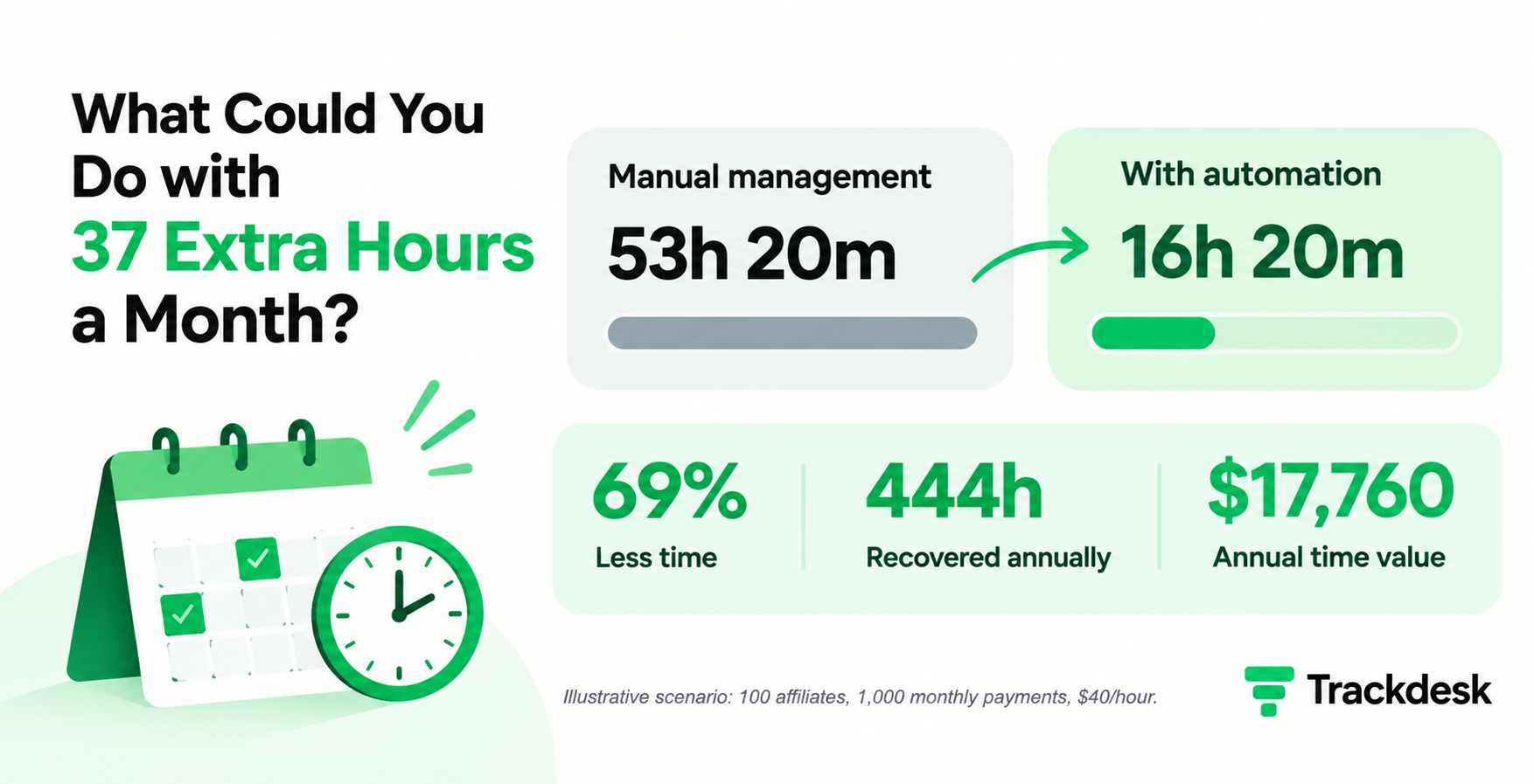
| Total monthly time | 53h 20m | 16h 20m | 37h |
These estimates are an example, not measured customer results or industry benchmarks. Your savings will depend on your workload and setup.
That's 37 hours back on your team's schedule every month. Almost an entire working week, with around 69% less time spent on these tasks.
Commission calculations alone account for 23 of those hours. At 90 seconds per transaction, calculating commissions on 1,000 payments takes 25 hours. With automated commission rules, that could come down to two hours of reviewing rules and checking sample transactions.
What does automation mean for your bottom line?
If an hour of affiliate management work costs the business $40, recovering 37 hours every month gives you $1,480 worth of working time back. Over a year, that's 444 hours, valued at $17,760.
The salary cost stays the same, but those hours are now available for partner development. If you're paying for overtime or outsourced admin work, you could also reduce those costs.
For your own ROI calculation, start with the time your team spends today and factor in software, integration, training, and payment-provider costs. The example excludes any additional savings from AI.
Affiliate management automation checklist for prop firms
Before switching to your new workflow, test it against the situations your team handles every month.
- Record the current workload. Count applications, purchases, investigations, payment preparation, and partner queries over a representative period. Include the exceptions that consume the most time.
- Agree the rules and owners. Affiliate management, operations, and finance should agree on eligible purchases, referral priority, rates, validation, and adjustments.
- Follow a trader through the difficult cases. Test a link/code conflict, a discounted challenge, a reset or renewal, a duplicate payment notification, and a reversal. Check the credited partner and amount at each relevant stage.
- Check a full payout cycle. Compare commissions and payments with your existing process, including exceptions. Confirm that your Trackdesk plan and payment provider support the setup you need.
- Check how much manual work remains. Track missing events, approvals, partner questions, and maintenance to see what you should automate next.
Want to see how this would work for your prop firm? Explore Trackdesk for prop trading and request a workflow demonstration. Bring your real commission rules, a challenge purchase, a reset or renewal, a refund, and a typical payout run. That way, you can see how the workflow handles the cases that take up your team's time today.
Frequently asked questions
Can prop firms automate affiliate management without replacing their existing CRM?
Yes. Affiliate tracking software can work alongside your existing prop CRM and payment systems. Your CRM supplies customer and transaction data, while the affiliate platform handles attribution, configured commissions, reporting, and settlement preparation.
How much does it cost to automate a prop firm's affiliate program?
The cost depends on your software plan, integration requirements, payment providers, and implementation needs. Compare these costs with potential overtime savings and the value of recovered working hours to estimate your return on investment.
Do you still need an affiliate manager if your program is automated?
Yes. Automation reduces repetitive administrative tasks, while affiliate managers remain responsible for recruitment, partner relationships, promotional compliance, commission strategy, and resolving exceptions.
Can you automate affiliate management without automating affiliate payouts?
Yes. You can automate attribution, commission calculations, reporting, and settlement preparation while retaining your existing payment process. Your finance team can review approved balances and handle transfers separately.

I've been in digital marketing since 2011, which feels like several lifetimes in an industry that reinvents itself every other Tuesday. My background spans B2B SaaS, e-commerce, and product marketing, and I love getting to know digital products inside and out.
At Trackdesk, I work on content, AI visibility, and a bit of everything marketing-related. I enjoy digging into data, testing new tools, and sharing what I learn in my articles.
Have a question or an interesting idea? Drop me a line!